Binary Tree
คำอธิบาย
Tree คือโครงสร้างข้อมูลแบบลำดับชั้น (hierarchical) ต่างจาก array, linked list, stack และ queue ที่เป็นเชิงเส้น Binary tree คือ tree ที่แต่ละ node มีลูกได้ไม่เกินสองตัว เรียกว่า left child และ right child
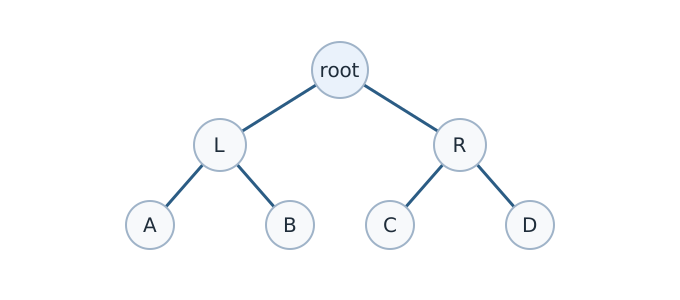
Binary tree. Original diagram for this guide.
คำศัพท์
       j        <-- root (depth 0)
     /   \
    f     k     <-- depth 1
   / \     \
a h z <-- leaves (depth 2)root: node บนสุด ไม่มี parent (
j)parent / child:
fเป็น parent ของaและaเป็น child ของfleaf: node ที่ไม่มีลูก (
a,h,z)subtree: node หนึ่งพร้อมลูกหลานทั้งหมดของมัน
depth ของ node: จำนวน edge จาก root ถึง node นั้น
height ของ tree: depth ที่มากที่สุด (tree ด้านบนสูง 2)
ชนิดของ binary tree
Full: ทุก node มีลูก 0 หรือ 2 ตัว
Complete: ทุกชั้นเต็มยกเว้นชั้นล่างสุดซึ่งเติมจากซ้ายไปขวา (เช่น heap)
Perfect: ทุกชั้นเต็ม มี 2^{h + 1} - 1 node เมื่อสูง h
Balanced: ความสูงเป็น O\left( \log n \right)
เมื่อไรใช้ tree
ข้อมูลที่มีลำดับชั้น เช่น ระบบไฟล์ ผังองค์กร
เมื่อรวมกับการจัดเรียงบางอย่าง เช่น BST หรือ heap จะค้นหา เพิ่ม และลบได้ใน O\left( \log n \right)
โจทย์กราฟจำนวนมากเป็น tree (กราฟ connected ที่ไม่มี cycle)
การเก็บ binary tree
ด้วย pointer
struct Node {
  int data;
  Node* left = nullptr;
  Node* right = nullptr;
};

Node* root = new Node{1};
root->left = new Node{2};
root->right = new Node{3};
root->left->left = new Node{4};
/*
        1
      /   \
     2     3
    /
   4
*/
ด้วย array ของลูก (นิยมในการแข่งขัน)
โจทย์มักให้ node เป็นหมายเลข 1..n พร้อมลูกซ้ายและขวา เก็บใน array ได้ทันที (0 = ไม่มีลูก)
int L[N], R[N]; // L[u], R[u] = ลูกซ้าย/ขวาของ uด้วย index (สำหรับ complete tree)
ถ้าเป็น complete tree และเริ่ม index ที่ 1: ลูกของ i คือ 2i และ 2i + 1 และ parent คือ \left\lfloor \frac{i}{2} \right\rfloor ไม่ต้องเก็บ pointer เลย (ใช้ใน heap และ segment tree)
Traversal
การเยี่ยมทุก node มีสามแบบหลักตามจังหวะที่ประมวลผล node เทียบกับลูก
| ชื่อ | ลำดับ | ผลกับ tree ตัวอย่าง (1, 2, 3, 4) ด้านบน |
|---|---|---|
| Preorder | node, ซ้าย, ขวา | 1 2 4 3 |
| Inorder | ซ้าย, node, ขวา | 4 2 1 3 |
| Postorder | ซ้าย, ขวา, node | 4 2 3 1 |
| Level order | ทีละชั้น (BFS) | 1 2 3 4 |
void preorder(Node* t) {
  if (t == nullptr) return;
  cout << t->data << ' ';
  preorder(t->left);
  preorder(t->right);
}
// inorder และ postorder สลับตำแหน่งบรรทัด cout
ลองดู traversal ทั้งสี่แบบทีละ node ได้ใน widget ของบท Binary Search Tree
คำนวณค่าด้วย recursion
หลายคำถามเกี่ยวกับ tree ตอบได้จากคำตอบของ subtree ซ้ายและขวา
int size(Node* t) {    // จำนวน node
  if (t == nullptr) return 0;
  return 1 + size(t->left) + size(t->right);
}

int height(Node* t) {  // ความสูง (tree ว่าง = -1, node เดียว = 0)
  if (t == nullptr) return -1;
  return 1 + max(height(t->left), height(t->right));
}
ทั้งสองฟังก์ชันเยี่ยมทุก node ครั้งเดียว จึงเป็น O(n)
Tree ทั่วไป (ลูกกี่ตัวก็ได้)
ในโจทย์ส่วนใหญ่ tree ไม่จำกัดจำนวนลูก ให้เก็บแบบ adjacency list เหมือนกราฟ แล้ว DFS โดยจำ parent ไว้เพื่อไม่เดินย้อนกลับ
vector<int> children[N];
int sub[N];  // sub[u] = จำนวน node ใน subtree ของ u

void dfs(int u) {
  sub[u] = 1;
  for (int v : children[u]) {
    dfs(v);
    sub[u] += sub[v];
  }
}
โจทย์ฝึกฝน (Practice Problems)
ลองทำโจทย์เหล่านี้จาก CSES Problem Set เพื่อฝึกใช้ทักษะจากบทนี้ โดยเริ่มจากโจทย์ที่ง่ายที่สุดก่อน
Subordinates (ขนาด subtree)
โจทย์เพิ่มเติม: CSES Problem Set และ programming.in.th